

Not that long ago, I was at dinner in Toronto with a table full of executives. (Side note: some of the best Indian food is in Toronto. It seriously rivals New York and London. I may be biased, since half my family lives in Mississauga, but I stand by it.)
At one point, the CEO of a very large professional services firm put a question to the table. Her words: “We are using AI. But how much is it really helping? How much value has it driven for the business? We don’t know.”
I hear some version of that in nearly every boardroom I’m in, and the numbers back it up. Last fall, KPMG surveyed 753 Canadian business leaders, and 93 percent said their organizations were using AI, up from 61 percent the year before. Two percent said they were seeing a return on their generative AI investments. Two. Adoption keeps climbing, the budgets and the tools are in place, and for most teams the day-to-day work hasn’t changed much since 2023. It’s like the old ad asked: where’s the beef?
That gap costs Canada more than most. According to Statistics Canada, for every dollar of value an American business produced per hour of work in 2017, a Canadian business produced about 76 cents. By 2021, it was down to 70 cents. That’s a strange spot for the country where a lot of modern AI was born, in Geoffrey Hinton’s lab in Toronto and Yoshua Bengio’s in Montreal.
My take is that most companies have used AI to do the old job faster. The payoff comes from changing the jobs themselves.
Humans Are New at This
Something I’ve been thinking about a lot: humans are actually pretty new to bureaucracy. Sumerian scribes were pressing grain tallies into clay tablets about five thousand years ago. China ran an imperial civil service exam for roughly 1,300 years, from 605 to 1905, which fed one of the longest-running bureaucracies on record. That sounds old until you zoom out. Humans have been around for about 300,000 years. Squeeze all of that into a single day, and we’ve been doing paperwork for about the last 24 minutes.
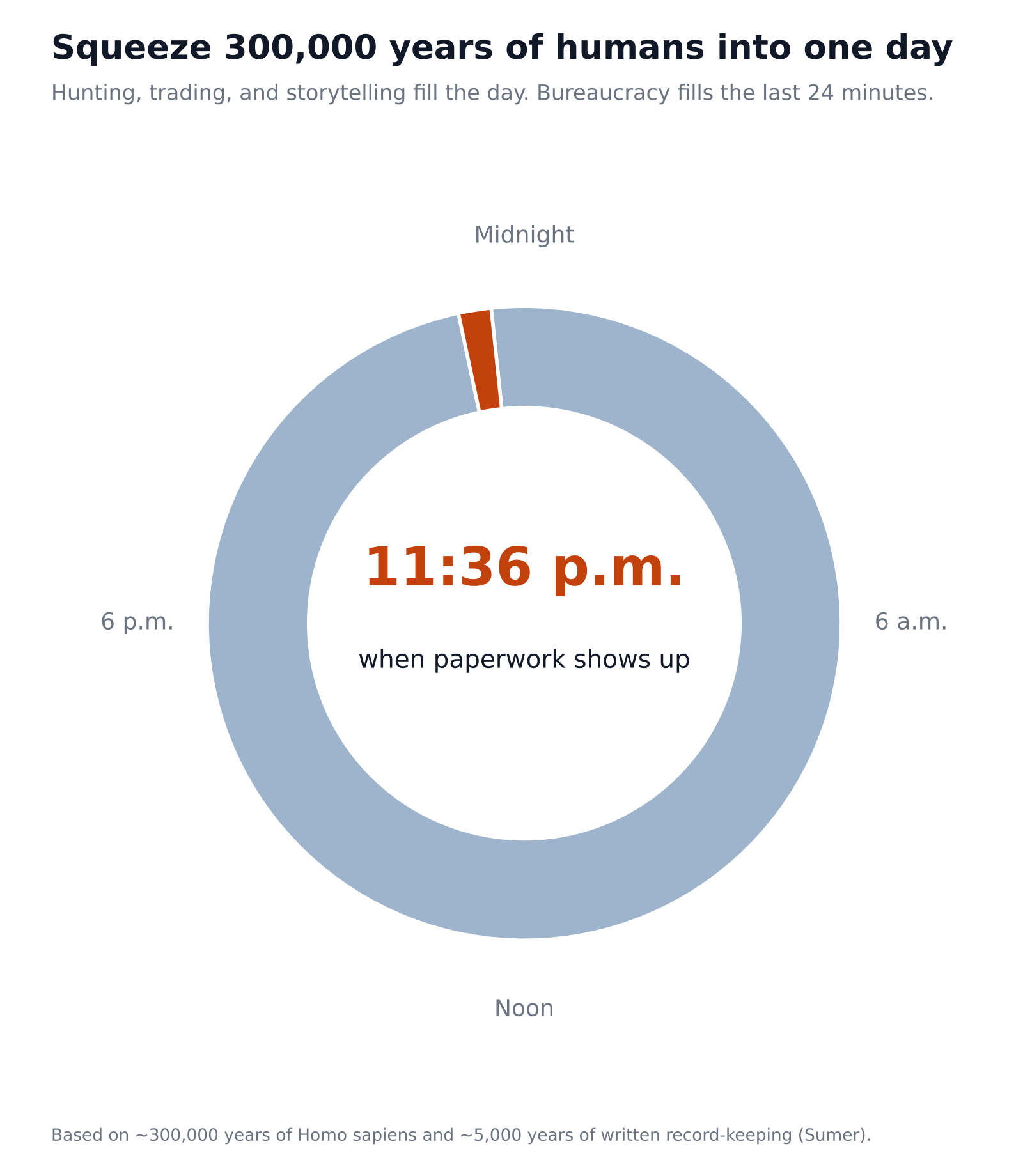
Before that, we were hunting, trading, telling stories, and reading each other’s faces around a fire. I wrote about how much of that campfire wiring still runs our businesses in The Campfire is Running Your Business. We still react to the loudest voice in the room, because that’s what our brains spent almost all of history doing. Forms and filing ask for something completely different, which is why most of us have a low-key dislike for them.
AI, on the other hand, is natively bureaucratic. It can read every policy, every precedent, and every prior file, and apply the rules the same way on the ten-thousandth case at 3 a.m. as it did on the first. It can check every contract a firm has against a new regulation overnight. No team of people can do that.
So far, most corporate AI has gone into faster emails, cleaner meeting notes, and quicker first drafts. That’s fine. It’s also exactly why nobody can find the macro value. Speed up a task without changing the job around it, and the minutes you saved just get absorbed into the rest of the day. Nothing on the scorecard moves.
You’ve probably heard that AI won’t take your job, but someone who understands AI will. I care less about who takes whose job and more about what jobs become. Changing work means changing roles, incentives, and how the workforce is set up. I’d ask every leadership team two things. What are you holding people accountable for? What outcomes do they actually have to deliver? If the answer is “the same stuff, just faster,” AI will keep feeling helpful and keep barely showing up on the balance sheet.
Take Away the Fluff and See What’s Left
I don’t think we realize how much fluff the last 30 or 40 years have added to office work: status reports nobody reads, decks that summarize other decks, approval chains with six signatures, the meeting before the meeting. A lot of it is bureaucracy we invented to manage other bureaucracy.
Once AI takes over that layer, you have to ask what’s left of the job. For some roles, plenty: judgment, relationships, making the hard call. For others, less than people would like to admit. Either way, the bar goes up. People need to be more strategic and more focused on outcomes, because the busywork that used to prove they were working is gone.
Think about the industries that run on process: banks, insurers, pension funds, professional services firms, government. I’ve worked with plenty of them over the years, and the pattern is the same from Toronto to New York to Hong Kong: layers of approvals and reporting built to manage risk, and whole roles organized around feeding them. That’s a lot of bureaucracy for AI to take over, and a lot of roles that need rethinking.
People also have to trust it, and a lot of them don’t yet. What wins over a skeptical workforce is being straight with them about which work is going away and what they’ll be measured on instead, and setting clear rules about what AI decides on its own and what still needs a person. Some companies are already there. Shopify’s CEO told employees last year that AI use would be part of their performance and peer reviews. Change what people get reviewed on, and the value follows.
When Analysis Gets Cheap, Field Reporting Gets Valuable
And it isn’t only the paperwork. Pulling data, building models, spotting patterns in a spreadsheet, all of that keeps getting cheaper and faster. What becomes more valuable is what I’d call field reporting: the signals you can only pick up by being in the store, on the floor, or on the call.
I was on a call recently with Doug Wood, the CEO of Tommy Bahama, and I asked him whether he’d ever noticed a shift in his customers before it showed up in the numbers. He didn’t hesitate. In his 25 years with the company, one of the biggest changes he’s seen is mothers and daughters shopping together. His wife, he told me, would never have taken anything out of her mother’s closet. Now he watches mothers and daughters in his stores handing each other clothes. The daughter says, “Oh, this is gonna look really cute on you,” while she’s thinking, “Buy that, Mom, because I’m taking that from you.” Some days he has three generations in a store at once.
That’s a customer signal. Customers are one of the core signals in my upcoming book, Seven Signals, and this is a textbook example. A signal is an early sign that something may be changing. A trend is what we call it once everyone can see it, and by then most of the advantage is gone.
No dashboard flagged that. Doug saw it standing in his own stores, where he says he’ll spend hours talking to people. When I asked how he trains his team to catch signals like that, he talked about sending them out. His design leads go to Europe and South America. His restaurant team goes to Mexico City and LA’s food truck scene, which is where the idea for a smaller, faster Marlin Bar concept came from. That’s what I mean by Signal Scouts: people whose job is to notice when behavior starts to shift, and to bring it back while there’s still time to act.
Then come the questions only people can answer. What does it mean for the assortment, the marketing, the store layout? Who gets to act on it, and how fast? Doug’s direct reports have worked with him for 13 years or more, so they move quickly, and they feel empowered to disagree when they see something differently. That’s the loop I lay out in Seven Signals: see, interpret, act. AI is the accelerant. Human behavior is the signal, and somebody still has to be close enough to see it.
What I’d Tell That CEO
When I give keynotes on AI and business transformation, the question I get more than any other is the one she asked: where does the value actually show up? My answer is that it shows up as volume, as leverage, or as innovation.
Volume is what you already do, at a scale nobody else can match. A firm that can answer every RFP instead of picking three, or personalize every client conversation, starts winning on math. But volume is the easiest advantage to copy, and volume of the wrong thing just produces more fluff.
Leverage is putting AI at the one spot in the work where a change moves everything after it, then rebuilding the job around that spot. Take a fashion brand that uses AI to turn a designer’s sketch into a realistic product on a model before anything gets made. Design sits upstream of everything. When the team can see the product before it exists, they can test more ideas, kill the weak ones before anyone pays for a sample, and get merchandising and marketing moving sooner. Change that one step, and everything after it changes with it.
Innovation is doing what simply wasn’t possible before. Professional services firms have talked for decades about charging for results instead of hours, but when every deliverable runs on people’s hours, the billable hour is how a firm covers its risk. Once AI is handling the hours, a firm can finally price the outcome and still make money. That opportunity is sitting right in front of firms like the one that Toronto CEO runs. I tell leaders to stop asking how to make things more efficient. That’s a narrow question. Ask what was impossible yesterday that’s possible today.
So if we’d had another hour at that dinner, I would have told her to stop measuring how much faster people do the old job. Pick one team and write down what they’re actually accountable for. Decide whether that team’s AI play is volume, leverage, or innovation. Cut the work that only exists to feed the bureaucracy, give the rest of the bureaucracy to AI, and rebuild the role around outcomes and the signals that team is in the best position to see. Then measure the outcome. That’s how you answer her question.