


A few weeks into our summer cohort, I’m on a call with one of our Rewired fellows. She starts to tell me about how productive she’s been since she started implementing what she’d learned. I jump right in with my usual enthusiasm: “That’s great! This stuff is such a game changer, right? And, of course...”
She interrupts me mid-sentence, and this time her tone feels serious, almost somber. “Shama, I don’t think you understand. <serious pause> I’m 60. This is the most productive I’ve ever been.” She stresses every syllable.
She wanted what this meant to her to truly land with me. In that moment, it did. This is someone who is a leader, serves on boards, and has had a storied career. She had spent an entire career getting good at her work, and the most productive stretch of it started the month she learned to build with AI.
For the last year, Yves Hughes, Rewired’s AI technical lead, and I have had the pleasure of working with some of the best leaders in the country. We sit down with these leaders and their teams, find where the hours go, and build alongside them. It’s forward-deployed work. The build is the easy part, though. What I care about is whether they can do it without us: rebuild it, break it, and rebuild it again. We teach people to fish as much as we build for them, because the person who learns to build keeps building long after we’ve gone home.
Meanwhile, the most coveted hire in tech is the outside version of that person: the forward-deployed engineer, a specialist a vendor embeds inside your company to build your AI systems. In 2025, companies posted nearly 13 times as many of these jobs as they did the year before, a 1,165% jump according to Bloomberry’s analysis of 1,000 FDE listings, and October 2025 set the all-time monthly record.
Companies are renting the people who build their AI, and what those people build expires on someone else’s release schedule.
So I’ve started calling people like her something: forward-deployed executives, or FDX for short. And I think every leader needs to become one.
A forward-deployed executive, or FDX, is a leader inside the company who goes into the work, rebuilds it with AI, and keeps rebuilding it as the technology changes.
Inside means they’re already on your team and already trusted by the people on it. The work means they start with how people actually spend their day, before anyone picks a tool. And keeps is in there because the AI you deploy this quarter will be outclassed by something better before your next board meeting. Every system an FDX builds makes the next one faster, so their value compounds the longer they’re with you.
This is where I think the future is. Forward-deployed engineers are cool, and they’re a subset of this. You’ll also see firms selling a “forward-deployed executive” who parks inside your company for a few months and then leaves, which is a glorified name for a consultant. The forward-deployed executive I’m talking about is you. It’s the skill set every leader needs now, and it isn’t optional. You ignore this at your own peril.
Even Palantir Planned for the Engineers to Leave
Palantir created the forward-deployed engineer, and the AI labs took the model mainstream. Internally, Palantir calls them Deltas, and its own description of the job is revealing: Deltas build right next to the customer, stay with the users when the software goes live, and “enable the client’s IT teams to build independently.” The finish line was always the customer’s own people doing the building.
I’m a fan of the role. When you need something built fast in a domain your team doesn’t know, an embedded engineer is the right call. The trouble starts when the engagement ends. The engineer moves on to the next customer, and the know-how goes with them. Then a new model ships, the old one gets retired, and you’re back on the phone.
Side by side, the two roles look like this.
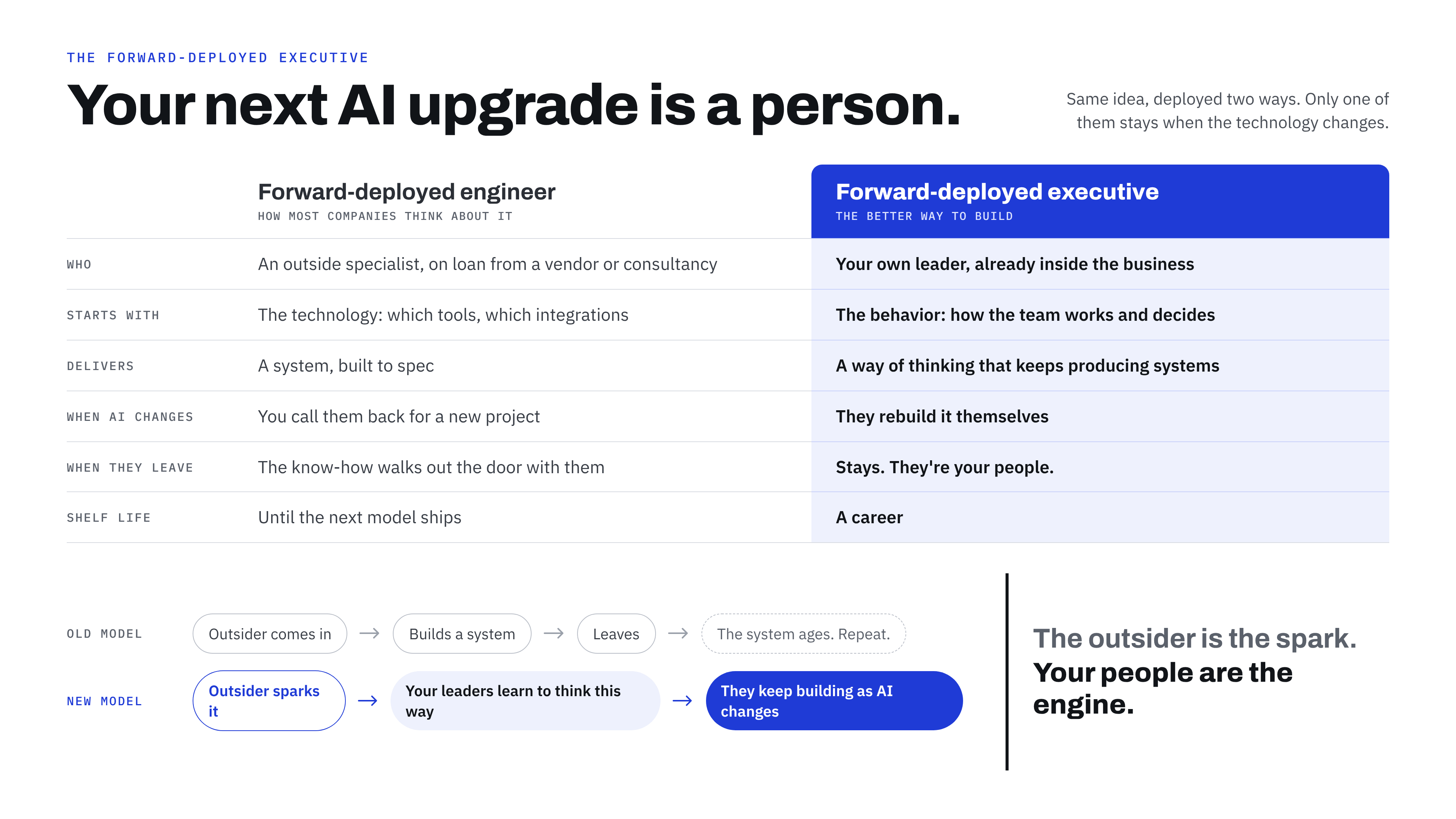
Your AI Has an Expiration Date
A forward-deployed engineer’s work lasts until the next model ships. An FDX’s lasts a career.
Sometimes the platform doesn’t even wait for the next model. On September 24, OpenAI switched off the Sora API, less than a year after launching it at DevDay on October 6, 2025. In March, the company had announced it was shutting Sora down to put the compute toward coding tools and enterprise customers. Every company that paid someone to wire Sora into a marketing workflow last fall now owns a pipeline that points at nothing.
Sora is the extreme case. The ordinary version happens every few months: a new model makes last quarter’s workaround unnecessary, a vendor changes its pricing, a tool your team loved gets folded into something else. Every system you run is a snapshot of what the models could do the day it was built.
If you use ChatGPT at work, you’re living through one right now. Custom GPTs launched in November 2023, and plenty of executives spent two years building them for proposals, onboarding, and board prep. In September, OpenAI announced it’s retiring them in favor of plugins, with migration deadlines running into February.
None of that building was a mistake. Not everything sticks, and that’s part of innovation, even if we don’t love it. The custom GPT you built for board prep is going away, but the muscle you built making it isn’t. Tools will keep coming and going. How you work stays with you.
You Can’t Outsource This Part
AI projects mostly stall for human reasons, and they’re stalling more often. In 2024, S&P Global found 17% of companies had scrapped most of their AI initiatives. A year later, it was 42%, even as the models got dramatically better.
What’s missing is someone who can change how the team works and bring people along with it. Those are executive skills, and you can’t fly them in on a contract.
Daron Acemoglu, the MIT economist who shared the 2024 Nobel, makes the same case in the first issue of The Humanist Review of AI, Microsoft AI’s new magazine. Power stations were running in London and New York by 1881, he points out, and four decades later about half of homes and factories still did without. He expects AI to take even longer, because someone inside every company has to decide which tasks go to the model and which stay with people. He calls the better path “pro-worker AI”: tools that make people stronger at the work they already do. My 60-year-old fellow is what that looks like on a Tuesday.
I’ve said for years that AI is the accelerant and human behavior is the signal. An FDX reads the signal: how the team really works, which tasks people quietly avoid, what they’d automate if someone finally asked. The promise of this moment is that you no longer have to be technical to build. You do have to change how you work. A professional in 2030 will work in ways that would look strange in most offices today, and the people building those habits now are the ones companies will be competing for.
It Started With a Memo About Soap
In May 1931, a young Procter & Gamble manager named Neil McElroy wrote a three-page memo. He was in charge of advertising Camay soap, which kept losing ground to P&G’s own Ivory, and he argued that every brand needed one person accountable for it from top to bottom. He called that person a “brand man.” Within a generation, brand manager was a job title, then a career track, then the bench P&G pulled its leaders from. McElroy became the company’s president in 1948 and Eisenhower’s Secretary of Defense in 1957. All from a three-page memo about soap.
Consider this my memo. (Although, definitely don’t call me to be the Secretary of Defense.) In 1931, “brand man” wasn’t a thing. Today, FDX isn’t a thing either. It will be. The pattern hasn’t changed much since McElroy: someone does the work before it has a name, someone names it, and then the people already doing the work grab the name, because it tells their story faster than their old title could.
An FDX has stopped using AI as a tool. It isn’t a tab they open when they’re stuck. It’s where they work all day, and it has made them 10x more productive than they were before.
You can spot one quickly. They talk to their AI instead of typing at it. They don’t use ChatGPT as a smarter Google; they hand an agent a real job and check what comes back. When an idea comes up in a meeting, they have a rough prototype before the meeting ends. When they send their team an update, each person gets a version built around what that person needs to know. They ask better questions, because answers that used to take weeks now take minutes, and they have the discernment to catch the model when it’s wrong. Fluency without that discernment just produces bad work faster.
Put together, an FDX can take their best work, the thinking that used to fit into a few good hours a day, and scale it across everything they touch. That’s a different job from the one most leaders are doing, even when the title is the same.
So, my prediction. Within a year, “forward-deployed executive” will start showing up next to job titles, the way “Six Sigma Black Belt” once sat beside “VP of Operations.” It tells you what that person can do that the title doesn’t. And within a few years, companies will start requiring it of their leaders. GE rolled out Six Sigma under Jack Welch in 1995, put every employee through the training, and tied promotions and bonuses to it. I expect boards to start asking the AI version of that question about every leader they promote: does this person work inside AI, or do they just use it?
Companies will ask for it because the gap between leaders who work this way and leaders who don’t is getting too wide to ignore. And the market is starting to price that in. An FDX is worth more to the company they’re in, and to every company that would like to hire them away.
The leaders who already work this way are the ones every company is about to fight over. I wrote about what happens when they walk out the door in Your Best Performers Are About to Leave.
If that person isn’t you yet, it needs to be.
The Bar Just Moved
Earlier this month, I was on a panel at the Female Quotient lounge during Advertising Week New York about how AI is rewriting leadership, alongside leaders from SharkNinja, Weber Shandwick, and AWS. SharkNinja’s Michelle Crossan-Matos told the room the company had shut down for a full week so all 4,000 people could build AI solutions to their biggest customer pain points. She also said she spends hours every week teaching herself, because she wouldn’t have a real seat at the table in the debate over AI guardrails otherwise. Anthony DeMaio of Business Insider, who moderated, closed by saying AI is raising the bar for leadership.
He’s right. Being able to rebuild the work yourself is the next level of leadership, and it’s quickly becoming the new bar. What I told the room is that my worry runs opposite to the headlines. Everyone asks whether we’re moving too fast with AI. Inside companies, day to day, we’re moving too slowly, and the gap I see widening is between leaders who are building and leaders who aren’t.
You don’t have to join Rewired to become a forward-deployed executive. But you don’t get to skip the learning anymore. You have to invest the time. You can teach yourself, which is completely fine, or you can learn alongside peers in a room where it feels safe to not know things yet. Either way, you just have to start.
If You’d Rather Shortcut the Learning
Rewired, my AI fluency program for executives, exists to produce exactly this person. Every Rewired graduate is a forward-deployed executive, and they can say it without exaggerating: “I’m a forward-deployed executive. I’m a graduate of Rewired.”
The design follows the definition. Right after someone enrolls, we ask what they’re doing right now that they’d like to automate, and that answer becomes their first build. We set up their machine with them, and one of the first things we install is Wispr Flow, so they can talk to their AI instead of typing at it. I think keyboards are on their way to obsolete for this kind of work, and I’d like our fellows to get there first.
Most of what a leader knows about how the work really gets done has never been written down. It lives in their head, in the way they’d explain it to a new hire over coffee, and the keyboard is where most of it gets lost. At the first Rewired workshop, around my dining table in Miami, the turn came at about 2 PM, when people stopped typing and started talking and found they were moving three to five times faster. I wrote about that day in Your Brain Wasn’t Built for This. An FDX thinks out loud for a living, and now the machine can keep up.
Over six weeks, fellows build their own systems on their own work, with Yves and me in the room. Handing someone a finished system would create exactly the dependence an FDX exists to end, so we don’t. The promise is three working systems, and if a fellow doesn’t have them by the end, we keep working with them until they do.
Fellows can also bring a plus-one to build alongside them: a colleague, an assistant, or, my favorite version, their kid. And membership outlasts the cohort: every future live class is included, which you’ll want when the models keep changing underneath you.
With Roster & Co., we’re doing this with whole departments and teams: we embed with one team, measure where the hours go, and train the leaders who’ll carry it to the next team after we’re gone.
If you want to be a forward-deployed executive, you can join our next cohort. Cohort 3 starts Tuesday, October 13, and runs six Tuesdays at noon Eastern, with 20 seats. everything is recorded, and you are a member for life.
Whichever way you learn, the test for whether you’re doing it right is very simple. Are you humbled every single day? Are you blown away by what’s possible every single day?
There are only two types of people left in the world now: people who are absolutely blown away every 10 minutes, and people who aren’t. The future belongs to only one of them. Can you guess which one?
Definitely the most productive year I've had in a while, but its not just AI. But it helps tremendously.
The question of whether the team can keep building after the outside help leaves stuck with me. We’re developing software around how our beverage service business actually operates, and there’s so much context in people’s heads. I like the emphasis on starting with where their hours go before choosing a tool.