
How Far Behind Are We, Actually?
What the Hyder Index reveals for August 2026, and why the number moved in a direction it never has before.

In the summer of 2024, McDonald’s gave up on AI at the drive-thru. IBM had spent three years building the voice ordering system, and TikTok needed about three weeks to break it: bacon on a customer’s ice cream, hundreds of dollars of chicken nuggets nobody asked for, one woman pleading with the machine to stop adding butter to her order. McDonald’s pulled the system from more than 100 locations by that July.
A year later it was Taco Bell’s turn in the barrel. A customer ordered 18,000 cups of water to force the voice AI to hand him to a human, the clip went everywhere, and Taco Bell’s chief digital and technology officer, Dane Mathews, said something to the Wall Street Journal you almost never hear an executive say on the record: “Sometimes it lets me down, but sometimes it really surprises me.” The rollout, past 500 stores at that point, slowed while the company worked out when the AI should take the order and when a person should.
That was last August. Fast forward to now - this August, Taco Bell’s AI is taking orders at nearly 900 drive-thrus, running comparable technology to the one that humiliated McDonald’s. What changed? A year of retraining the system, writing handoff rules, and teaching stores how to run the thing.
Taco Bell was gentle compared to State Farm. In June, State Farm scrapped the contracts of all 19,000 of its human agents (the people, not the software; that word works double shifts now) and made daily AI use a condition of staying, with OpenAI-built tools like Navi for instant quotes baked into the new deal. For context: Progressive just took the number one spot in auto insurance, a title State Farm had held since World War II. The human agents who refuse the new terms get exit packages of $50,000 to $300,000 and a door.
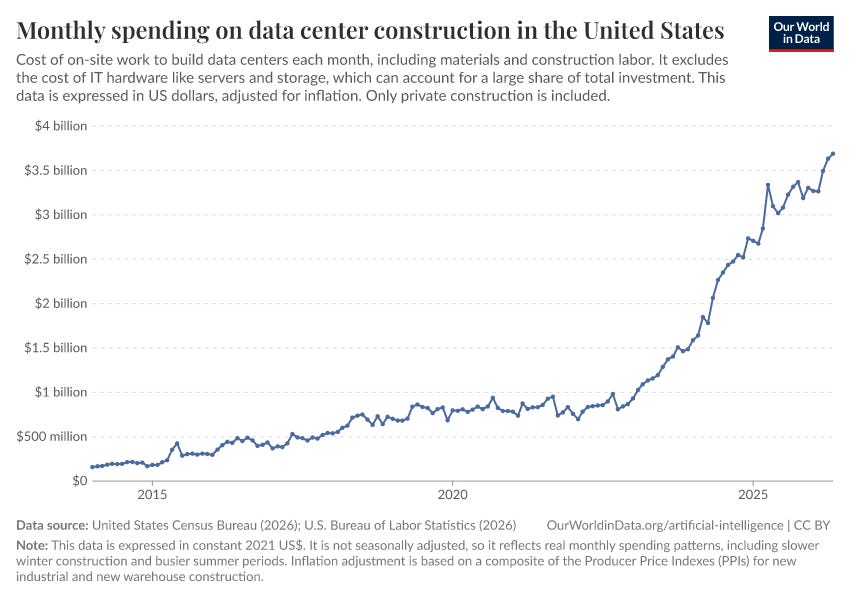
And in the same economy, with the same tools on the shelf, home builders responded to a cooling housing market the only way they know how: slashing prices and throwing in upgrades, the same playbook they’ve run since the mid-nineties. Data center construction hit $81.5 billion for the year, already more than all of 2025, while the companies that build the houses people actually live in met the moment with… coupons.
Some organizations are treating this as a rewiring. Others are treating it as weather. For three years, in almost every boardroom I’ve walked into, someone has pulled me aside to ask a version of the same question: “How far behind are we, actually?” Always quietly, and usually after the official agenda, which tells you how loaded the question is.
They don’t want a gut feel. They want a number. And until this year I didn’t have one to give them, because the numbers we track weren’t built for the question. We measure adoption to death: how many companies bought tools, how much budget moved. Adoption tells you who went shopping. It tells you nothing about who’s keeping up, or how wide their Response Gap is growing while they shop. So I built the thing I kept wishing existed!
What the Response Gap Actually Measures
It’s called the Hyder Index, and on the first Tuesday of every month it publishes one number: how fast industries are changing versus how fast the companies inside them are responding. The distance between those two is what I’m calling the Response Gap, and it’s the number I want every leadership team arguing about this year.
The index tracks 15 industries, from healthcare to hospitality. Each month, every industry gets two scores. The first is built on the framework I’ve spent my career developing: six signals of where a market is actually moving, which is to say what customers are doing, where talent is going, where money is flowing, what the rules and incentives are forcing, what the culture is absorbing, and what just broke.
The second score tracks what companies did about all of it: hiring, training, product moves, operational shifts. Basically, strategy that survives contact with a budget, not the “strategy” that lives in a press release.
Too many people call AI a trend. A signal is an early indication that something may be changing. A trend is what we call that change once the pattern is established and broadly visible, and by the time everyone agrees something is a trend, much of the advantage is gone. Surprise! AI is neither a signal nor a trend. It’s an accelerant, the way electricity was, the way the internet was, the way social media was.
Accelerants don’t create human behavior. They change its speed, its scale, its intensity. And we happen to be living through something genuinely unusual: three of them in a single generation. Our biology never evolved for that pace, which is why our sociology keeps lagging behind it. (I wrote about that tension in The Campfire is Running Your Business.)
Signals tell you where the game is going, and they are human every time: what people buy, where they go to work, what they trust. The index doesn’t score the accelerant. It scores whether organizations are responding to what their humans are already doing. That’s the bridge between observation and action: signals appear, leaders interpret which ones matter, organizations act before the window closes.
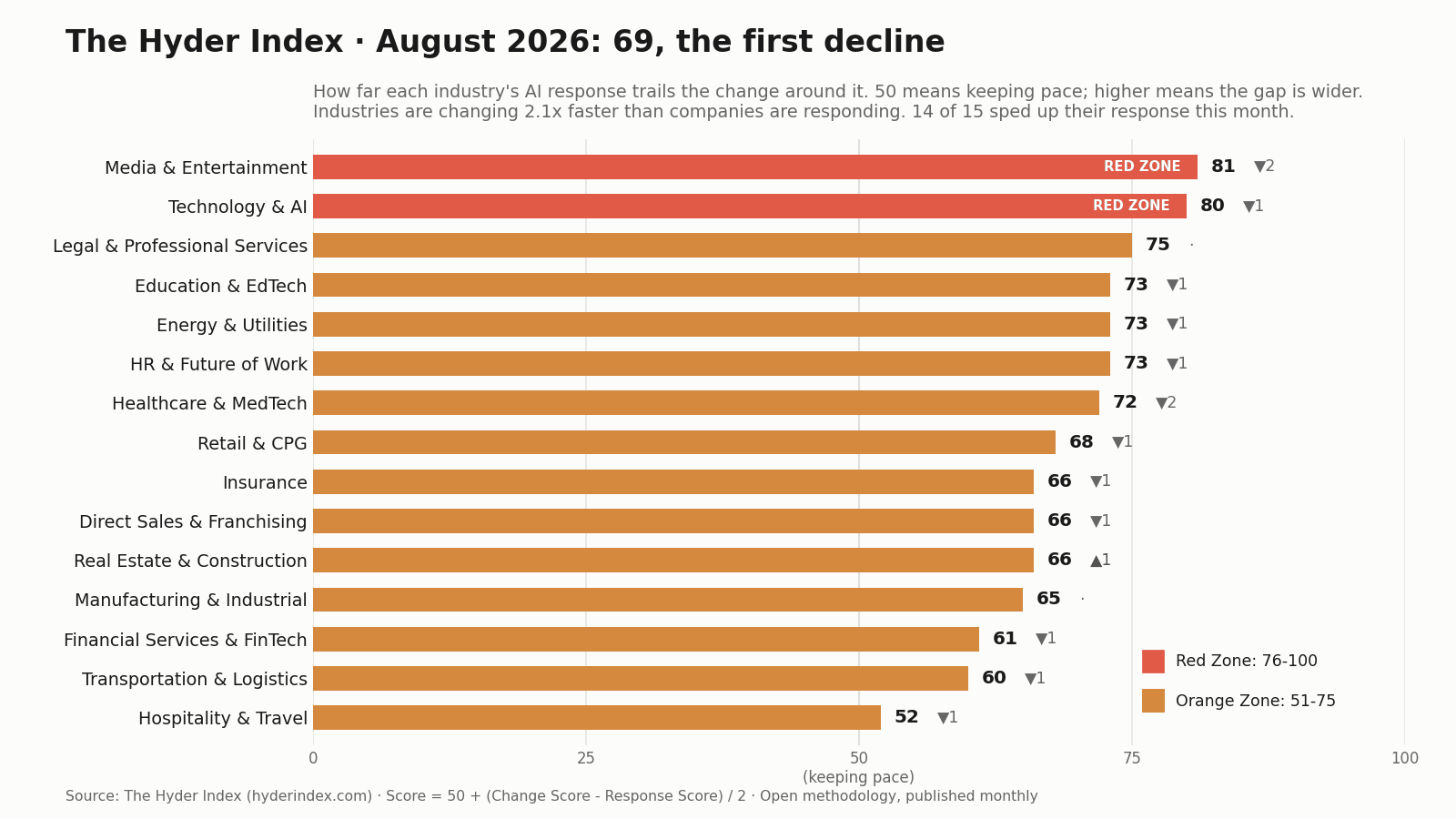
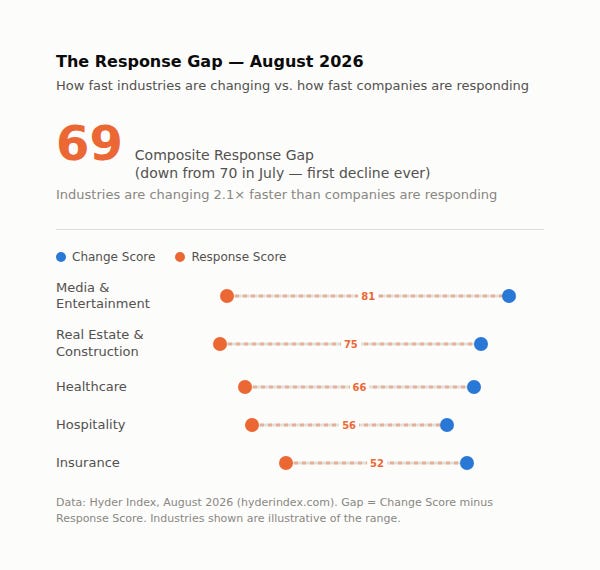
August’s composite Response Gap is 69, sitting in the significant-gap zone, with anything above 75 considered critical. In plain terms: industries are changing 2.1 times faster than companies are responding.
In January I published The Year of the Great Fracture, my call that 2026 would split the companies that respond from the companies that watch. The index is me putting a ruler on my own prediction, in public, every single month.
The First Time the Number Ever Fell
The August reading is 69, down from July’s 70. A small move by design, and a first: the index has never declined before. Better still, it fell for the right reason. Change rose 0.7 points in August. Response jumped 2.1, three times as much, and 14 of the 15 industries answered faster than they did in July. The gap narrowed because the response side finally outran the change side.
What made August different is that the response showed up in operations, not announcements. Look at what shipped in a single month:
Netflix disclosed that its creative partners used generative AI across roughly 300 titles in the first half of 2026, mostly in post-production: VFX, crowd scenes, relighting shots, filling gaps in documentary footage. One documentary, The American Experiment, produced 17 minutes of AI-enhanced footage “twice as fast and at half the cost,” per CEO Ted Sarandos.
England funded a 10 billion pound, three-year AI program for the NHS.
Marriott and IHG shipped AI-powered booking tools in the same window.
Media and entertainment, the widest gap on the board at 81, narrowed for the first time in five months; one in ten entertainment job postings now targets an AI role. And exactly one industry moved the wrong way: real estate and construction, the industry from the top of this piece, where billions pour into data centers while the companies that build homes meet the moment with coupons.
The Tools Arrived Before the Training Did
Now the acutal story under the story…the one I’d bring to your Monday meeting.
On July 28, the Conference Board published the finding that explains the next year of this index better than anything else I read all summer:
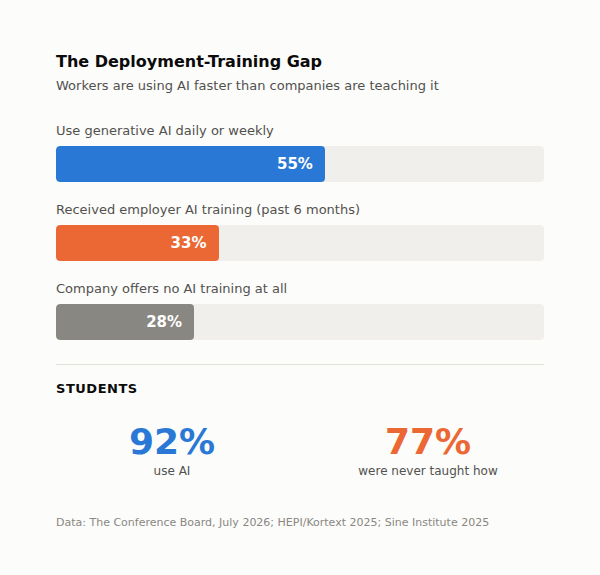
55.1 percent of workers now use generative AI daily or weekly, while 33.3 percent received any employer-provided AI training in the past six months. More than a quarter, 28.3 percent, say their company offers no AI training at all. And the training that does exist mostly covers basic prompting, a 2023 curriculum, while companies deploy 2026 systems. Students are further along and worse served: 92 percent use AI, 77 percent were never taught how.
Call it deployment theater if you want. The invoices are real, so it feels like progress. But a tool nobody was trained on is a line item, and line items don’t close Response Gaps. Look back at the drive-thru. McDonald’s and Taco Bell ran comparable systems and hit comparable viral embarrassments. One shut it down at 100 stores. The other spent a year training the software, the franchisees, and the crews around it, and now runs 900. The distance between those outcomes is everything wrapped around the model.
State Farm is about to run the biggest live experiment on exactly this. Writing daily AI use into a contract puts 19,000 people on the tools by decree. Whether the company teaches those people to be good at the tools, on work time, with real support, is what its Response Score will show over the next year. (Watch that one with me.)
This is the accelerant-and-signal distinction playing out in real time. Models improve on their own schedule. Whether your organization improves is a set of human decisions, made or ducked, week after week. That’s the part worth measuring, because that’s the part you control.
The next advantage goes to the companies that teach their people to use what they just bought. That part has barely started, which means it is still there for the taking. I am certainly doing my part with Rewired!
If you run a team, the audit takes one afternoon. Count the AI tools your company pays for. Then count the hours of training that shipped alongside them. The distance between those two numbers is your own Response Gap, and closing it is the cheapest competitive move available to you this quarter. Give the training a name and an owner while you’re at it. In the August data, the companies pulling ahead had somebody accountable for making the tools stick.
First Tuesday, Every Month
The index publishes on the first Tuesday of every month. All the data is free, down to the CSV. And every month, right here, I’ll bring you three things: the number, the one story that matters most, and what I’d do about it if I were sitting in your chair.
September’s edition answers the question August just raised: was this the month companies started closing their Response Gap, or a breather before it opens again? I have a guess, but you’ll have to wait to hear it. ;)