

In 2007, a professor told me I was wasting my time studying “lunch updates.”
I was finishing my master’s thesis on social media, back when Twitter had fewer than 2,000 users and a good share of them were posting what they ate. After graduation, I applied to eighteen consulting firms. All eighteen turned me down. Social media was a fad, they said. Focus on something serious. (Beat it, kid! Scram!)
So I took $1,500 (basically every dollar I had at the time), plus the support of my immigrant parents, who had no idea what Twitter was but figured self-employed was more respectable than unemployed, and started Zen Media. Over the years that followed, many of those same firms hired my agency to do the exact work I had applied to do for them.
I think about that a lot, because for the longest time I didn’t understand why they didn’t see (…or act on) what was clear as day to me. Those firms and I were looking at the same internet. How could we come to such dramatically different conclusions? What I learned would lead to this book.
In June, three publishers bid on my next book, Seven Signals. The auction closed at six figures, and the book now has a home at Simon & Schuster’s Simon Acumen imprint. (Yippee!) A close colleague asked me recently how I landed it. The short answer: I did exactly what the book tells you to do. I read the signals I saw and acted on them.
The longer answer is about pull. Some books and products get pushed into the world because their makers believe in them. Others get pulled into it by what’s already moving: what customers keep asking for, where talent and money are going, who suddenly values what you have. Those are signals. Pull is what it feels like when you read them right. I walked into that auction with evidence of pull: the same question after keynote after keynote, a monthly index tracking the problem across 15 industries, and a framework hundreds of executives had already tested. When AI can turn out a passable manuscript in an afternoon, ideas get cheap. Pull stays scarce, and scarce things get bid on. That’s as true for your next product as it was for my book.
The clearest way to show you the difference is two of my earlier books: one that was pulled, and one I pushed.
Three Signals, Staring Right at Me
The book is about a discipline I call Strategic Urgency. Signals show up long before trends do. You see the signal, you interpret what it means for you specifically, and you act while the window is still open. Skip a step and you end up like those eighteen firms: technically aware of an opportunity, but practically too late to act on it.
In 2007, three signals were waving at me. The customer signal was that every business owner I met asked me some version of the same question: what am I supposed to do with Facebook? The culture signal was at SXSW and Blog World Expo, where the conversation had moved to these platforms long before the Wall Street Journal noticed. And the disruption signal was the big one: social media was rewiring how people found, judged, and talked about the companies they bought from.
I read them, decided the window for a social media book was open, and took action. I started with an ebook so I could respond to the signal right away, and that led to a bigger book with BenBella. The Zen of Social Media Marketing came out in 2010. It went through four editions and six languages and has sold more than 100,000 copies.
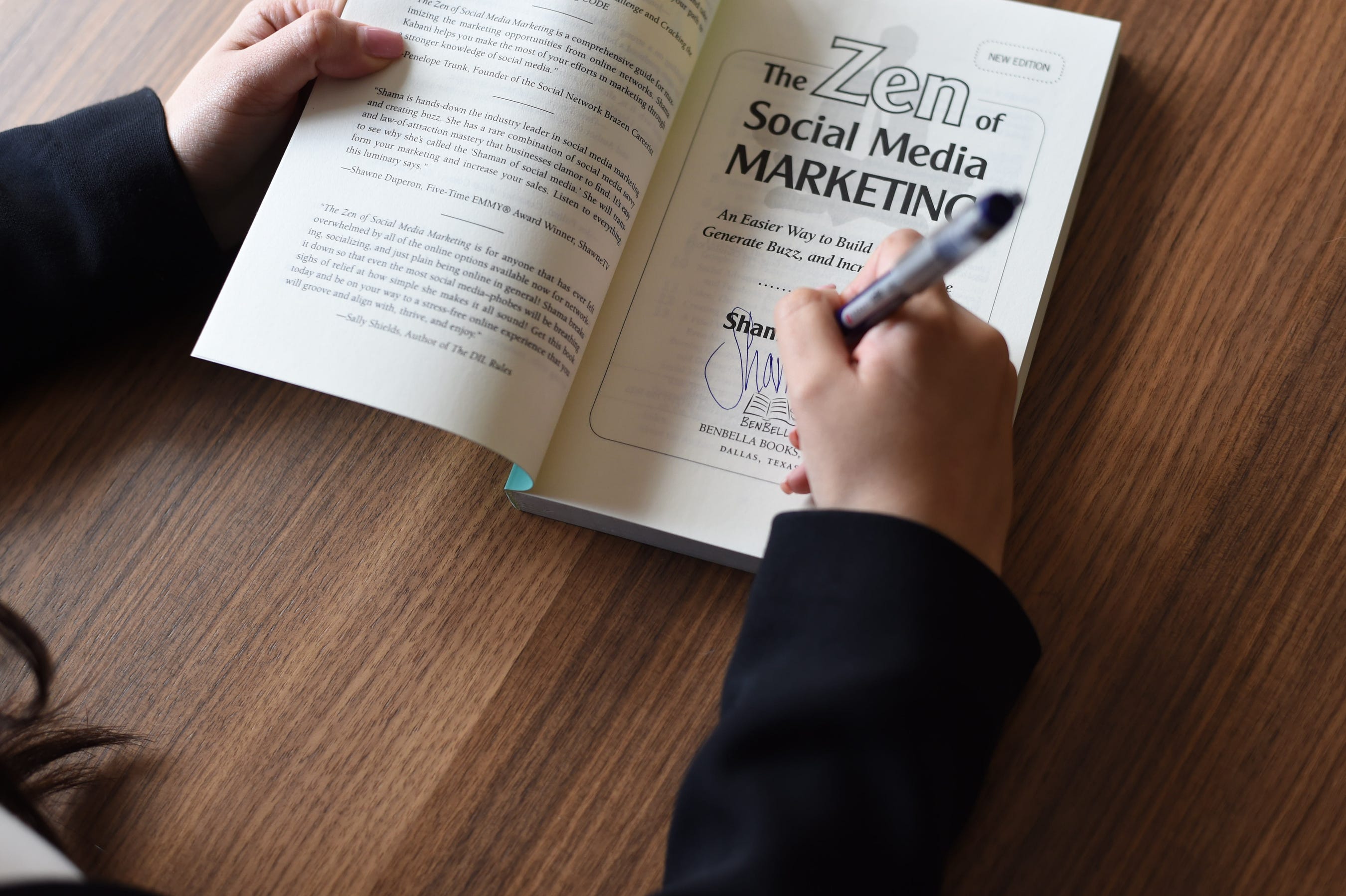
Drumroll, please, because that number needs context. According to BookScan, about two-thirds of new titles from the biggest publishers sell fewer than 1,000 print copies in their first year, and fewer than 2 percent cross 50,000. I’d love to credit my writing for beating those odds. The real credit goes to timing: readers were searching for that book before I wrote it.
The Good Book That Taught Me the Most
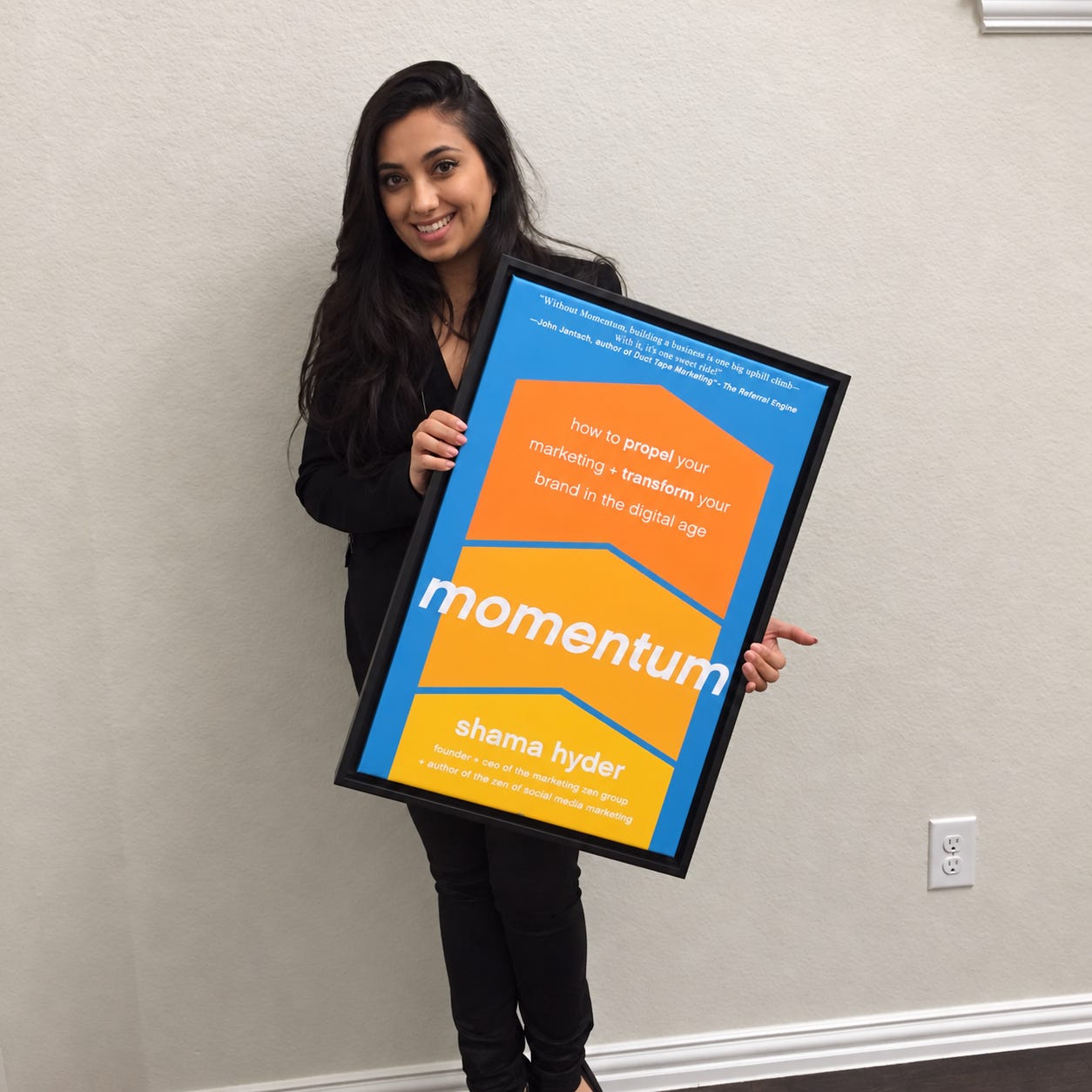
Momentum came out in 2016, and I’m proud of it. Its argument was that marketing had gotten far more complicated than it needed to be, mostly because companies kept chasing short-lived tactics and neglecting a handful of lasting fundamentals. Before you chase the next shiny thing, ask whether it fits your customers, your industry, and your market. Swap “shiny thing” for “AI tool” and that advice is more useful today than when I wrote it. One question from the book has aged even better: what will doing business with us allow our customers to say about themselves? When AI can make anyone’s product look competent, the answer to that question is a big part of what’s left to compete on.
Momentum didn’t reach Zen’s level, though, and for years I blamed the usual suspects: a crowded shelf, a busy news cycle, bad timing. With the lens I use now, I can see it plainly. I wrote Momentum because I believed people needed the information. It wasn’t a response to a signal I had tracked and then acted on. (The irony: the very first principle in the book was agility. Watch your data and respond fast. I wrote the advice and skipped it.) Zen was pulled into the world. Momentum was pushed. Pushed work can still find readers, but it has to fight for every single one of them.
That’s the gap between good and excellent, and I watch companies fall into it every quarter. A smart team ships a solid product and it doesn’t land the way leadership thinks it should. Everyone blames the market, or the marketing team. Off with their heads! The market was usually talking the whole time. Sometimes the team didn’t read the signals. Sometimes they read them and never stopped to ask which ones were theirs to act on. And just as often, someone on the team spotted the signal, read it correctly, and could not, for the life of them, get leadership to act on it in time.
So I Waited
I didn’t write another business book for almost a decade, which is a long time for someone whose job is speaking, writing and sharing ideas. I explored several concepts in those years, but none of them lined up with the signals I was seeing, and I didn’t want to write the wrong book.
Part of the reason was what Momentum taught me about timing. Part of it was that the shelves were already full of good business books, and I had no interest in adding another “good enough” one. I wanted to write something that would still be useful ten years from now. So I kept watching.
Then the questions changed. After almost every keynote, someone walks up to the stage. For years they asked about tactics. Then CEOs, store managers, and VPs in completely different industries started saying versions of the same sentence to me: we can see everything changing, but we can’t tell what deserves a real response.
That was a customer signal, and I was hearing it loud and clear. AI had sped everything up, and leaders were drowning in noise and starving for signal. The five-year plan had stopped surviving contact with the market, and the alternative everyone reached for, jumping at anything that looked like a signal, was burning out their teams. They needed something in between. I’d been teaching it to clients for years. There just wasn’t a book they could hand to their people.
I felt the stakes personally, too. I genuinely believe the next five to ten years will be a bloodbath for people and companies that can’t separate signal from noise.
I also believe it’s a skill anyone can learn, and the organizations that come out ahead will be the ones that turn their people into signal scouts. That’s a book worth writing.
So I built the case before I wrote the proposal. The Hyder Index measures the Change-Response Gap, the distance between how fast an industry is changing and how fast its companies respond, across 15 industries every month. I tested the framework with CEOs, store managers, keynote audiences, and Rewired cohorts. By the time my agent, Janet Goldstein, took the proposal out, hundreds of executives had already put it through its paces.
Then the publishing world sent its own signal. One of the signals in the book is Incentives: who disproportionately values what you can offer right now. In 2024, Simon & Schuster launched Simon Acumen, a new imprint devoted entirely to business books. A new imprint needs books that tell the world what it stands for, and a book about how leaders decide what deserves a response showed up right on time.
Choosing a Publisher Was a Signal Test Too
I loved all three publishers, which made this harder. The best decisions usually are.
One offered something nontraditional: no advance and a generous profit split. I believe in this book, so the math didn’t scare me, and money was never the deciding factor. (I am a lucky duck. I know.) Still, an advance is a signal in its own right, because it shows you who’s willing to put skin in the game. Publishers see a staggering number of manuscripts, and most of their bets lose. Industry insiders say that about half the books a house publishes even make money, and a much smaller share earn back their advance. So the advance tells you how much a publisher is wagering on you. It tells you very little about what they plan to do with the book.
The two six-figure offers were close enough that the editor tipped it. Stephanie Hitchcock got the book almost instantly. In our first conversation she was already talking about where it could go, and I left the call thinking about how to take two years of work to the next level instead of how to explain it.
That feeling mattered, because this book is the spine of everything I do now. My work is turning leaders, and frankly anyone willing, into forward-deployed executives: people who work inside AI every day and use it to win. AI creates agency at an unprecedented level, and I want that for a lot more people than the usual few. Boardroom, cohort, or classroom, every room I’m in runs on the question this book answers: what deserves a response, and how fast? I wanted a partner who was clocking the same signal.
Run It on Your Own Idea
If you’re sitting on something you believe in, whether it’s a book, a product, a pivot, or a new offer, start where I should have started with Momentum: check for pull. What are people already asking you for, over and over, in their own words? Who would disproportionately value what you’re building right now?
Then interpret before you act. Three questions straight from the book:
Would you be upset if a competitor did this first?
What advantage makes this more valuable for you than for anyone else?
Is there a window, and are you still inside it?
If the answers come back fuzzy, you may have a good idea the market isn’t ready to reward yet. Keep it, and keep watching.
As for me, I’m deep in the manuscript and collecting case studies everywhere I go, like a little bird bringing things back to the nest. In 2007, eighteen firms saw the signals I saw and waited for proof. This June, three publishers looked at the evidence and bid on a book that didn’t exist yet. The signals for your next move are probably sitting in your inbox and your sales calls. I get it, though. Waiting for proof feels safer, but ask those eighteen firms how that worked out.
Love the insight. Can’t wait to read and share!
Does pull = demand? Or do you see a difference? And when you start to hear certain signals, is there a tipping point where you say, ok, I’ve got something real here? Do you measure or is it more anecdotal?