

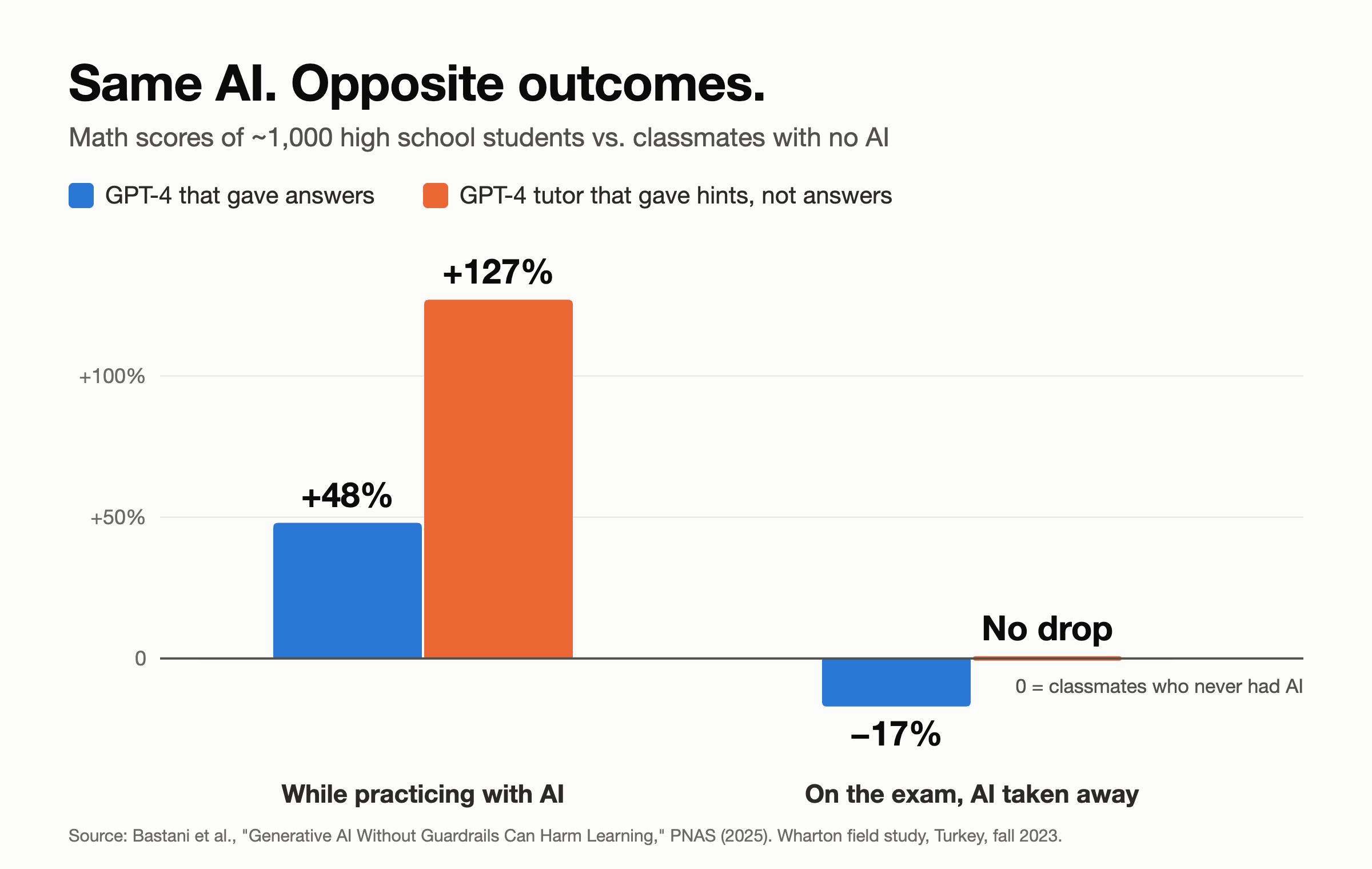
A few years ago, researchers at Wharton gave nearly a thousand high school math students in Turkey a GPT-4 tutor for their practice sessions. Practice scores jumped 48 percent. Then the researchers took the AI away for the exam, and those same students scored 17 percent worse than classmates who never had it at all. (Womp, womp.) But a second group used the same AI, set up differently, and walked into the exam with no damage. Hold that thought.
I think about that study a lot. I teach Communication in the Age of AI at Link School of Business, and I let my students use AI on their midterm. I spend my weeks training executives to build with it. If AI is really a crutch dressed up as a coach, I'm part of the problem.
So I read Venkatesh Rao's new essay, Cognitive Mercantilism — twice. (Yes, I know I used an em dash. Please calm down.) It makes the most optimistic case I've seen against the idea that AI is dumbing us down, and I agree with most of it.
There's one hole in it, though, and the Wharton kids fell right through it.
Rao Is Right About the Gold
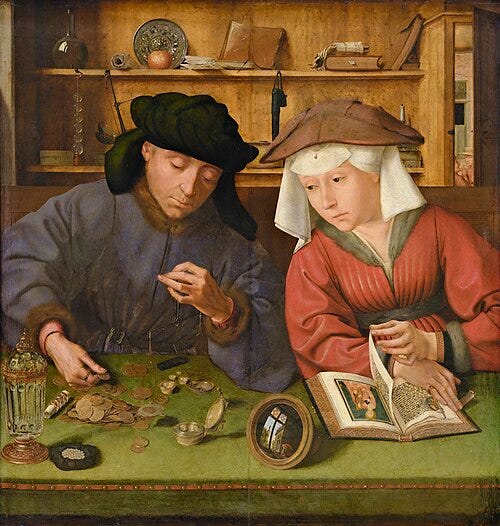
Quick history lesson. Mercantilism ran European economics for a couple of centuries before Adam Smith (the guy who made the "invisible hand" famous) came along. Kings treated wealth as a fixed pile of gold and silver. If you wanted to get richer, you took a bigger slice from someone else, so you hoarded precious metals, guarded your colonies, and kept ordinary people working the land.
Basically, these people never heard of a win-win. It was a zero-sum world.
Smith flipped that. Millions of people chasing their own interest and trading freely end up making everyone better off, as if guided by an invisible hand. It turned out trade could grow the proverbial pie.
Rao argues that a lot of today's AI anxiety runs on that same logic, with intelligence playing the part of the gold. Smart people and what they produce get treated as a scarce stockpile to hoard and keep out of the wrong hands.
I see this in boardrooms all the time. The C-suite gets enterprise licenses while the frontline gets a policy memo, and legal locks everything down until there's a framework. It feels prudent, but mostly it's modern-day gold hoarding.
It also doesn't work, because people route around it. When Microsoft and LinkedIn surveyed 31,000 knowledge workers in 2024, 78 percent of AI users said they were bringing their own AI tools to work, and more than half were reluctant to admit using it on their most important tasks. Only 39 percent had received any AI training from their employer. Leaders were rationing intelligence while their people bought it on the side and hid the receipts.
Rao's second point is valid too. Plenty of people who look checked out have been making a rational call, he argues, because hard thinking didn't pay when they had no tools or access to do anything with it. In his words, "The returns on attention rise, and with them the incentive to pay attention." In my words, nobody wants to play when they can’t afford the buy-in. AI just made the buy-in cheap.
I can personally attest to this. A 60-year-old member of one of my Rewired cohorts told me her first month building with Claude was the most productive month of her life. Nobody had to make her think harder. She wanted to, because suddenly it paid.
Where the Grocery Analogy Breaks
Rao's central image is farming. In 1900, 41 percent of American workers worked in agriculture. By 2000, it was 1.9 percent. Nobody got dumber, and the country eats better than ever. (OK, maybe not better better, but we have more choice than any farmer in the previous century ever did.) By the same logic, Rao says, most of us won't need to produce intelligence to enjoy enormous amounts of it.
Hmmm. Let’s play this out. Farming is a production skill. You can lose it entirely and still enjoy dinner, because eating has nothing to do with knowing how the food was grown. Intelligence is the meal, but it's also the appetite and the taste. You need judgment to know what to ask an AI, to notice when the answer is wrong, and to want something worth wanting at all. Outsource all of that and the palate goes with it.
MIT Media Lab's Your Brain on ChatGPT study shows what that looks like. Researchers had 54 people write essays while wearing EEG headsets, some using ChatGPT, some using Google, some using nothing. After the first session, 83 percent of the ChatGPT group couldn't correctly quote a single sentence from the essay they had just finished. In the other two groups, it was 11 percent.
Follow the food analogy all the way through and it makes my case for me. Work stopped requiring physical effort and calories got cheap. In the early 1960s, about 13 percent of American adults had obesity. In the latest CDC data, it's 40.3 percent. Meanwhile, a record 81 million Americans, roughly one in four, belonged to a gym in 2025. We built an economy that stopped asking our muscles to work, and then we started paying a monthly fee to pick up heavy things on purpose. Huzzah!

Abundance didn't make us weaker or stronger by itself. It handed us the choice. Abundant intelligence will do the same.
The Campfire Takes the Shortcut
Earlier this year I wrote about how much of our ancient wiring still runs modern business in The Campfire is Running Your Business. For most of human history we lived in small groups around a fire, reacting to the loudest voice and saving energy wherever we could. Our brains are built to grab the shortcut.
That wiring explains both sides of the AI debate. The panic is campfire behavior, since doom is the loudest story at the fire and travels furthest. The dumbing-down risk is campfire behavior too. Hand a campfire brain an answer machine and it will take the answer and skip the struggle, unless something in the setup pushes back.
The Wharton study shows how much the setup matters. The researchers built a second version of the tutor, shaped with teacher input, that gave hints instead of answers. Practice scores with that version jumped 127 percent, and when the AI was taken away, those students did about as well on the exam as students who never had it. The crutch effect disappeared. Both groups used the same model in the same school, and the only real difference was the behavior the tool encouraged.
That study ran on GPT-4 in 2023, which in AI years is several lifetimes ago, and ChatGPT, Claude, and Gemini now all offer study modes that coach with hints instead of handing over answers. The better tutor already exists. People still have to choose it, which brings us right back to behavior.
The MIT team found something similar about order. People who wrote on their own first and got ChatGPT later showed stronger engagement and better recall than people who started with the AI. Think first, then let the machine make you better.
Watch the Behavior Before It Becomes a Trend
Rao's best history lesson is my framework in action. Before the first factory went up, ordinary households started wanting new things and putting in longer hours to afford them. Historians call it the industrious revolution (not to be confused with the Industrial Revolution and its factories, which came later). In my upcoming book, Seven Signals, that's a Customers signal: an early shift in human behavior, visible long before anyone called it a trend. By the time industrialization was obvious to everyone, the advantage belonged to the people who had noticed the desire shifting decades earlier.
The 78 percent of workers bringing their own AI to work is that kind of signal today. So is the split these studies keep finding between people who use AI to reach further and people who use it to stop reaching. For a leader, the useful question is which direction your own people are moving.
So stop hoarding. Give everyone access, along with a reason to think harder, which is exactly how the industrious revolution got going. Then borrow the Wharton tutor's design. Ask for the human draft or the human point of view before the AI pass. Celebrate the person who catches the AI's mistake. Promote people for their judgment, since volume is about to get very cheap. I tell my business school students that the real skill they're learning is knowing when to reach for AI and when to wrestle with the problem themselves first. I call it friction maxxing, and they are on board.
Rao is right that intelligence was never gold, and companies guarding it like a vault will look as dated as the mercantilists do now. The grocery half is where I'd keep watching. Intelligence behaves more like a muscle, and an economy that stops demanding we use it will produce some of the sharpest people who ever lived right alongside a lot of people who let theirs go. Which of those your company ends up with will show up in behavior long before it shows up in results. You don't need an EEG headset to see which way your team is headed. Listen for whether people bring you better questions than they did six months ago, or just faster drafts.