Write Too Well and Someone Will Ask You to Prove You're Human
We spent entire careers telling people to get better at communicating. The ones who listened are now the suspects.

In grad school, a professor tossed my exam onto my desk and announced, loud enough for the whole room: “What do you know, Ms. Hyder? You are intelligent!”
Mine was the only A on that midterm.
I went to his office hours and asked why he’d been so surprised. He answered honestly, I’ll give him that much. It was the sunglasses on my head. The high heels. The coffee I carried into class. I didn’t look like the person who’d score highest in a room full of MBAs. (Obviously, this dude did not watch Legally Blonde.)
It wasn’t the first time. In middle school, a teacher held my paper back and quizzed me after class before admitting he didn’t believe I’d written it myself. He meant it as a compliment.
I’ve been thinking about those two moments a lot lately, because the internet is now running the same interrogation at scale. We call it the AI slop debate. I think it’s actually about something much older: what we decide to do when work comes back better than we expected from the person who handed it in.
It gets stranger if AI was trained on your work. The other day, I put four passages into a very popular AI writing detector. It gave me a 100% score that it was AI-generated. Ok. Cool, cool.
Except the passages were from my book The Zen of Social Media Marketing…which came out in 2009. AI has been trained on our books, on our content, on good freakin’ writing.
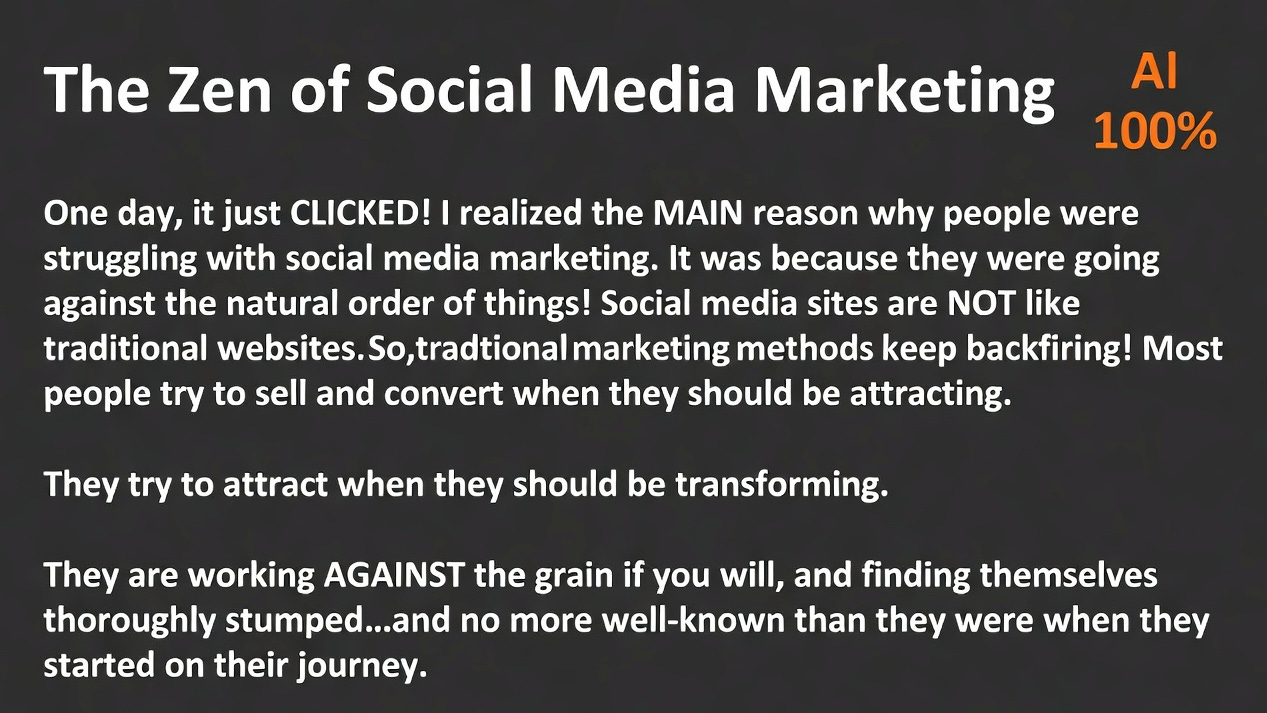
I kept thinking, what if I turn in my next manuscript and it gets flagged for being AI-generated? How do I prove it was really me?
The Skill Became the Evidence
Recently I was on a call with a guy named Jason whose voice is so polished that people assume it’s ElevenLabs. It turns out he spent years studying and coaching debate and speech. Basically, he’s a professional communicator. Someone asked him, in earnest, to prove he wasn’t AI. He waved his hands on video to prove he wasn’t.
I saw someone in Amy Webb’s LinkedIn comments the other day accusing her of using AI because her writing is polished. She has spent decades writing. Polish is what practice produces.
And once you see the pattern, it shows up everywhere, including at the top of the food chain. In April 2024, Paul Graham posted that a cold email pitching him a project had used the word “delve,” and that this had tipped him off it was written by ChatGPT.
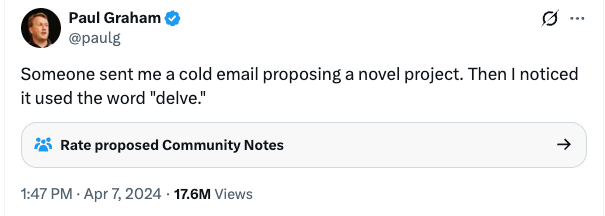
The replies filled with Nigerian writers pointing out that “delve” is ordinary, textbook English in Nigeria, the kind of word their schools drilled into them. What one of the most influential investors alive read as a machine fingerprint was, for millions of people, just an education. The same thing is happening to the em dash, a piece of punctuation writers have loved for two centuries, now treated as a confession. People are stripping it out of prose they typed with their own hands. I’ve quietly stopped using them myself, which proves the point better than anything else in this essay. (How do I stop using delve, though? This has been part of my vocabulary since I was in the third grade. Nigeria isn’t the only country where this is textbook English. I went to elementary school in India.)
For a full generation of careers, the advice never changed: work on your communication. Practice. Get better. It may be the single most repeated piece of professional advice of the past thirty years, and the people who actually took it are now the ones under suspicion. The skill itself has become the evidence against them.
I’ve started calling it the Polish Penalty. Sound too good, and someone decides you must be a machine.
The Interrogation Is Rigged
If the accusations were accurate, you could at least defend them as quality control. They aren’t accurate.
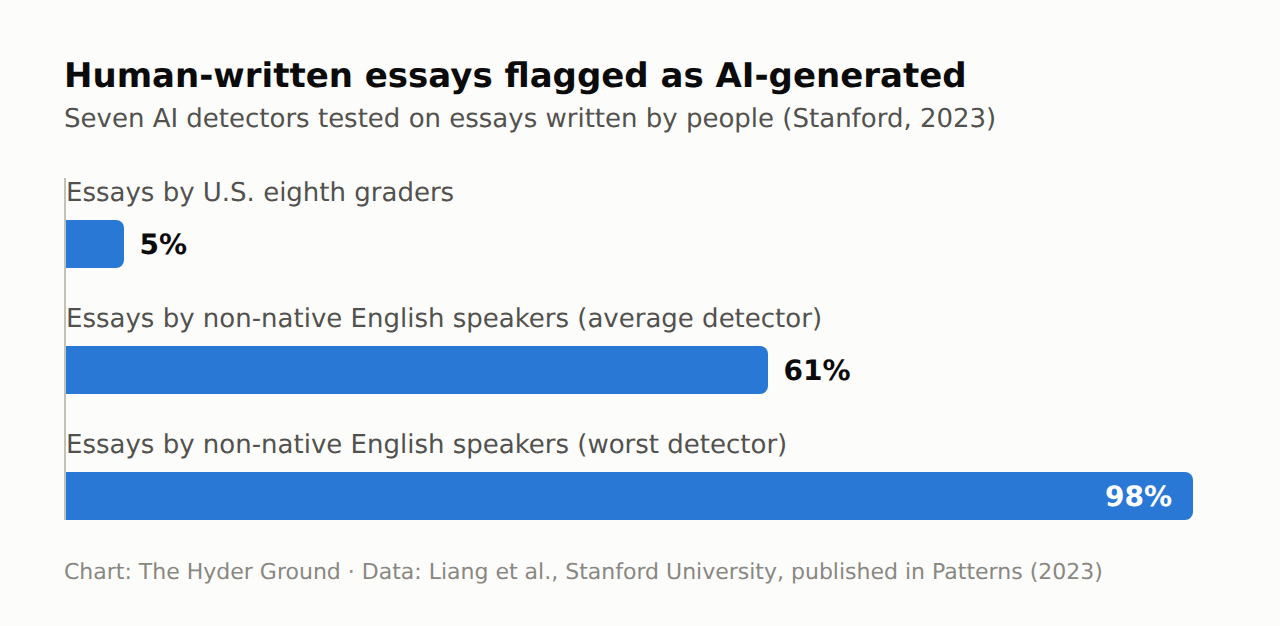
Stanford researchers ran human-written essays through seven popular AI detectors. On essays by American eighth graders, the detectors did fine, flagging around 5% by mistake. On English essays written by non-native speakers, the same detectors flagged 61% as AI-generated, and at least one detector flagged 98% of them. Put plainly: nearly every human writer in that sample failed a test of being human, because writing carefully in a second language produces the same measured, tidy prose the detectors learned to distrust.
The accusers can be even sloppier than the software. In May 2023, an instructor at Texas A&M University-Commerce named Jared Mumm pasted his students’ final essays into ChatGPT and asked whether it had written them. ChatGPT, which has no ability to recognize its own output, cheerfully said yes to essay after essay. Mumm threatened the grades of an entire class, and seniors who had already walked at graduation had their diplomas temporarily held while the university investigated. One student cleared her name with Google Docs timestamps and got an apology. The interrogator had outsourced the interrogation to the very thing he was policing.
For working writers, the verdicts land without the investigation. Kimberly Gasuras, an Ohio journalist with 24 years in local news, was flagged by Originality.ai on a freelance platform in 2023 and suspended with no warning; the money she’d relied on between reporting jobs disappeared. Another Ohio copywriter told Gizmodo his work scored “95% AI,” so he sent the client his Google Docs version history showing every keystroke. The client dropped him anyway. He lost 90% of his income to a probability score.
And the people paying the highest price are the ones who came to the skill the hard way: the second-language writers, the ones who studied, the ones who didn’t look the part and compensated by becoming undeniable on paper. I know that route personally. The interrogation always finds the same suspects. A 2024 Common Sense Media survey found about 10% of teens have already been falsely accused of turning in AI work; for Black teens it was 20%, versus 7% of white teens. My professor read sunglasses and heels. The detectors read sentence variance. Same reflex with a new instrument.
Watch what this is doing to the next generation. Students now record their screens while writing essays, or keep version histories as a defense file, because a detector’s false positive can end up in front of an academic integrity board. And the blue book, of all things, is on a comeback tour: the Wall Street Journal reported last year that sales were up roughly 80% at UC Berkeley over two academic years, with Texas A&M and Florida seeing jumps too, because handwriting in a cramped exam room is now the only prose we fully believe. I can tell you what they’re learning from all this. Some of it is caution. A lot of it is that excellence attracts prosecution, so maybe don’t be excellent where anyone can see.
One more wrinkle. I dictate a lot of my writing now, pacing my studio, talking into the air, with Wispr Flow catching every word. The transcripts come out clean because, after five hundred keynotes, my spoken sentences land pretty close to finished. Dictation is the most human way I’ve ever written. It is literally my voice. It also produces exactly the kind of polish that gets flagged. The tells have no access to how the work was made. They can only read how practiced you sound while making it, and then they hold the practice against you.
We Keep Asking the Wrong Question
We keep asking “Is this AI?” when the question that actually matters is “Is this good work?”
I did a talk at Sony Music a few weeks ago, and one of the executives asked a great question: “Is there power in a business saying they’re pro-AI or pro-human?” My answer was yes, right now, because the whole subject has become politicized. Five to ten years from now? I don’t think we’ll even be having this conversation. Nobody asks whether you used spell check. Nobody asks whether your presentation was designed in Canva or by hand. The tool disappears into the work, and the work is what gets judged. We are in the acute phase of a transition, and we are making it everyone else’s problem.
Plenty of mediocre work was produced by humans long before AI showed up.
Meanwhile, the accusation doesn’t accomplish what the accusers think it does. You are not going to shame someone into giving up AI. The models are only getting better. Worst case, someone used AI and the work is excellent. That person can direct a tool most of their peers are still fumbling with. Best case, they didn’t, and you just told a skilled human that their skill looks suspicious. Neither outcome moves us forward.
I keep coming back to who pays the price while we sort this out. I wrote in April about why trust is the moat that’s left when execution gets cheap. The people who built trust the hard way, by being twice as good because they had to be, are the same people now getting flagged.
In a few weeks, I start a professorship at the Link School of Business. I’ve been thinking a lot about what I owe those students, because the world they’re about to enter is an agentic one. AI won’t just assist their work. It will do parts of their work, end to end, on their behalf. There is no going back from that. The question I have to help them answer is not “how do you prove you didn’t use AI?” It’s “how do you develop critical thinking that’s worth something whether AI is in the room or not?” That’s a much harder question but at least it’s the honest one.
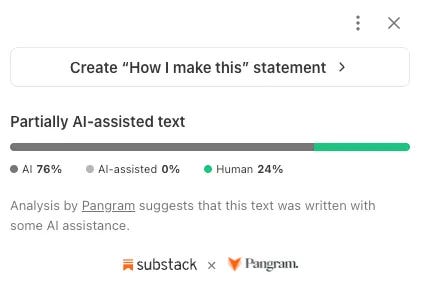
P.S. Just as I was about to send this, I ran it through Substack's own AI checker. It said 78% of this essay was AI-generated. I can wholeheartedly tell you that's just plain wrong. I can also tell you it kinda proves my point.